
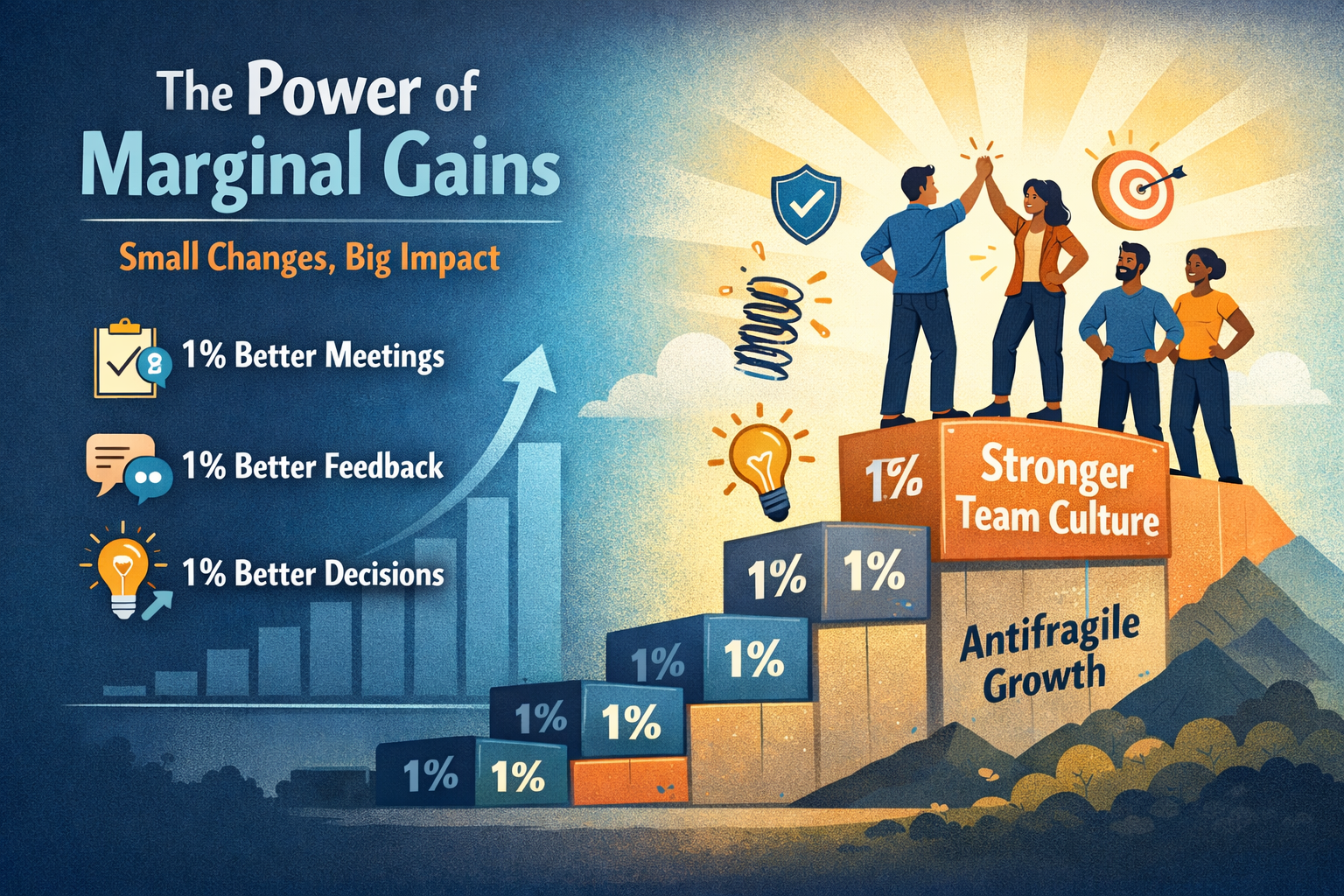
You don’t build a great team culture in a town hall. You build it deliberate 1% improvement at a time.
We tend to think culture change requires a big-bang restructure. New org charts. New leaders. A rebrand. A values reset workshop. Sometimes those things are necessary. But more often, culture shifts because of small, deliberate 1% improvements that compound over time.
The idea of marginal gains became famous through British Cycling under Dave Brailsford. Instead of chasing a single breakthrough, they improved dozens of tiny things — seat ergonomics, sleep quality, hygiene habits, recovery routines. Each gain was small. Together, they were transformative.
The same principle applies to teams.
A 1% improvement in how meetings are run — starting on time, clearer agendas, ending with actions — doesn’t feel revolutionary. But do it consistently and you create respect for time, accountability, and focus.
A 1% improvement in feedback — one extra sentence of appreciation, one clearer expectation — slowly builds psychological safety.
A 1% improvement in decision-making — documenting why a call was made — reduces politics and increases trust.
None of these requires big gestures. They require intent.
This connects directly to the idea of an antifragile team. In my earlier post, I explored how antifragility isn’t just resilience. Resilient teams withstand shocks. Antifragile teams get stronger because of them — a concept popularised by Nassim Nicholas Taleb in Antifragile.
But antifragility doesn’t emerge from slogans. It emerges from habits.
When a team does small after-action reviews instead of blaming, that’s a 1% gain. When leaders admit uncertainty instead of pretending control, that’s a 1% gain. When someone asks “what did we learn?” instead of “who caused this?”, that’s a 1% gain.
Each micro-behaviour slightly reduces fear and slightly increases learning. Over time, the team becomes less brittle. Stress becomes information, not threat. Failure becomes feedback, not identity damage.
Big restructures often try to force antifragility by shaking the system. Ironically, they can create fragility — uncertainty, politics, defensive behaviour. Marginal gains work differently. They strengthen the system from within.
There’s also something deeply empowering about this approach. Anyone can contribute a 1% improvement. You don’t need a new title. You don’t need a budget. You just need awareness and consistency and declipline.
If you’re leading a team, ask yourself:
- Where are the friction points?
- Where do small frustrations accumulate?
- Where does fear quietly live?
Now don’t redesign the whole organisation. Improve one small thing this week.
Over a year, 1% improvements compound. Culture shifts quietly. Trust deepens. Performance lifts. And when real pressure hits — market shocks, cyber incidents, organisational change — the team doesn’t just survive it.
It grows from it.
That’s how marginal gains become cultural transformation. Not dramatic. Not loud. Just deliberate. And powerful.