
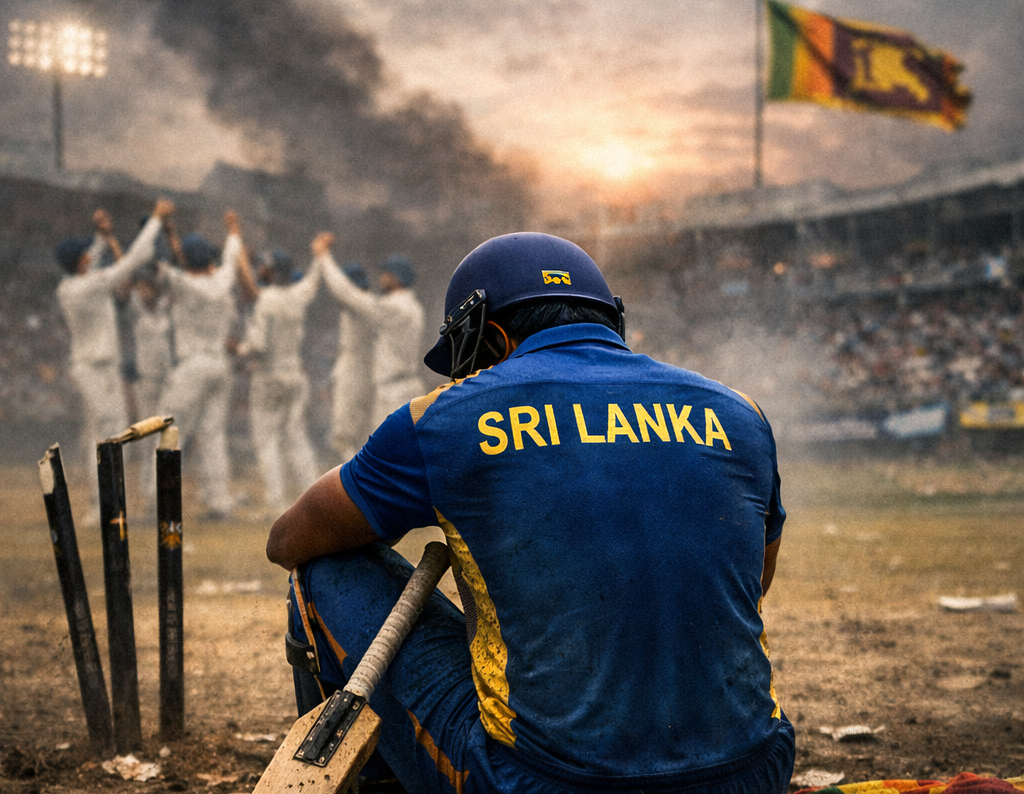
I grew up in Sri Lanka and played years of school cricket. I watched Sri Lanka win the 1996 World Cup and still remember the goose bumps. There was a time when the mere sight of the lion on the chest meant something. When teams didn’t just play against Sri Lanka — they braced for a fight.
From the audacity of Arjuna Ranatunga to the silk and steel of Kumar Sangakkara, from the ice-cold finishing of Mahela Jayawardene to the menace of Lasith Malinga — Sri Lanka once punched above its weight, repeatedly, unapologetically.
Today, we look competitive on paper. Occasionally dangerous. Rarely dominant. And almost never ruthless.
The uncomfortable question is: how did mediocrity become acceptable?
1. When Politics Sits in the Selection Room
Cricket in Sri Lanka does not operate in isolation from power. The governance structure of Sri Lanka Cricket has long been entangled with political interests. Administrators shift. Committees reshuffle. Selection panels change with suspicious frequency.
The issue isn’t simply “politics exists.” Every cricketing nation has power dynamics.
The issue is perception — and often reality — that:
- Selection lacks continuity.
- Long-term planning gives way to short-term appeasement.
- Players are in and out without role clarity.
- Accountability rarely travels upward.
Elite sport thrives on stability, meritocracy, and ruthless performance standards. When players believe external influence matters as much as on-field output, hunger erodes. Trust erodes faster.
Contrast that with the professional systems seen in countries competing under the umbrella of the International Cricket Council — high-performance frameworks, data-led selection, clear succession planning. Sri Lanka often looks reactive instead of strategic.
And reactive systems rarely produce champions.
2. The School-to-Club Cliff
Sri Lanka’s school cricket system is phenomenal. It is emotional. Tribal. Intense. Talented. Believe me, I played a lot of school cricket for Maris Stella. Every year, we witness 17- and 18-year-olds who look technically sound, confident, even international-ready.
Then something happens. Between school cricket and club cricket, development stalls. Why?
a) Intensity drops
School cricket carries pride — history, rivalries, packed grounds. Club cricket often lacks that theatre. Without intensity, competitive edge dulls.
b) Coaching standard becomes inconsistent
At the junior level, some schools invest heavily in coaching and facilities. At club level, player development pathways are fragmented. Technical refinement becomes survival mode rather than growth mode.
c) Fitness and professionalism plateau
Modern international cricket is brutal. Strength, conditioning, nutrition, recovery science — these are not optional extras. Too many promising players remain talented but not elite-athlete fit.
The result?
A wide domestic pool that is busy — but not brutally competitive.
3. Talent Without Killer Instinct
This is the hardest part to admit.
Sri Lanka still produces talented cricketers. Timing. Wrist work. Natural flair. Fast bowling potential. It’s all there.
What’s often missing is the killer instinct. The old Sri Lankan teams were not just skilled — they were defiant. They wanted to humiliate opponents. They squeezed. They hunted. They sensed weakness and accelerated.
Today we see:
- Collapses after strong starts.
- Defensive body language under pressure.
- Inability to close out winning positions.
- Acceptance of “almost.”
Elite sport is psychological warfare. The best teams believe they deserve to win. They carry quiet arrogance.
We, at times, look grateful to compete.
There’s a difference.
4. Systemic Consequences of Normalised Underperformance
When mediocrity becomes routine, three dangerous things happen:
- Fans lower expectations.
- Administrators justify inconsistency as “rebuilding.”
- Players lose fear of consequences.
Rebuilding cannot be a permanent state.
High-performance environments require:
- Clear role definitions.
- Long-term talent mapping (U15 → A team → national).
- Independent selection accountability.
- Sports psychology embedded at every level.
- Fitness benchmarks aligned to global best practice.
Without structural reform, talent alone won’t rescue us.
5. The Hard Truth — and the Hope
Sri Lanka is not lacking cricketing DNA. The country that won a World Cup and multiple ICC tournaments did not do so by accident.
But past glory cannot substitute present excellence.
If politics steps back.
If domestic cricket becomes ruthless.
If selection becomes transparent and data-driven.
If young players are conditioned not just to participate but to dominate.
Then the lion can roar again. The tragedy would not be decline. The tragedy would be accepting decline as normal.
And Sri Lankan cricket — at its best — was never normal.